Rough Transcript and Sources
Hello guys! Thanks for stopping by.
First things first- a big thank you to everyone who tuned into my intro episode. I’m overwhelmed by the love and support. Actually, I’m even going to give a few shout outs towards the end of the episode so stay tuned. And now- Welcome to my VERY first official episode (transcript).
The theme of this episode is identities.
I’m going to be dissecting the word ‘identity’ & the ‘in between’ feeling I mentioned in the intro. What does that ‘in-between’ personality/identity/ feeling even mean? Why is it important? I’ll even be talking a bit about privilege, entitlement and equity in regards to identity. Don’t worry if you don’t fully understand any of these terms. I’ll break ‘em down for you as we go. Now as a 23-year-old student I cannot say I have the credentials to make this information up. So, to maintain credibility for my podcast, I’m going to link all my sources in at the very bottom of this page.
Alright so let’s get into it.
I was inspired by this topic as an immigrant. As an immigrant, I felt so torn between being an ‘Indian’ and being an ‘American’. And then the label ‘Indian-American’. While it makes sense for a lot of people it just never made sense to me personally. Like you don’t go to France and see Indians call themselves ‘french indian’ or ‘African British’ or ‘mexican canadian’ you know? So it’s always felt a bit off. I think I recognize myself as my nationality now. And if someone is curious about my ethnicity I’m happy to identify as an Indian and talk about it.
But interestingly enough, I found everyone around me torn between SOME form of identity. Whether it is race, ethnicity, religion or even sexuality.
What is an identity?
According to the Merriam Webster dictionary, here’s the definition:
“is the qualities, beliefs, etc., that make a particular person or group different from others. “
Now I thought it was actually quite interesting when I looked up the definition of ‘privilege’
The dictionary says privilege is a
“a right or benefit that is given to some people and not to others”
but let’s put a pin on it for now
So when I was researching this topic of identities I came across these 8 big social identifiers-
1. Ability – Mental and/or physical
2. Age
3. Ethnicity
4. Gender
5. Race
6. Religion
7. Sexual Orientation
8. Socio-Economic Status/Class
Now often all of us fall into privilege in one category over another. And they evolve too so all these identities don’t necessarily have to stay the same. It’s actually quite subjective. So for example, I recognize my privilege as a straight person but I’m not as privileged when it comes to being a woman. And it varies too right? Like I might earn less than my male counterparts because of my gender but a fellow black woman might even make less than me simply because of our racial difference. So do I have privilege? Yes and no both.
I can’t be like oh I’m tired of being discriminated so just for tomorrow I’m gonna choose not to be an Indian. Right? Or I can’t just choose my socio-economic class tomorrow. All these identities make me ME. And they all intersect.

And that concept is what ‘intersectionality’ is basically. Intersectionality is a theory that was developed by Kimberlé Crenshaw, Professor of Law at UCLA and Columbia Law School.
It addresses how the intersection of a person’s identities is culturally and systemically weaponized to oppress them on multiple fronts. It is actually directly connected to generational trauma. We’ll talk about generational trauma in some other episode because there is so much to dig over there.
I think in the brown community I’ve heard a lot of ‘oh well we pulled ourselves up from bootstraps why can’t they?’ or ‘I made it with 2 dollars in my pocket’ or ‘your parents gave you so much how dare you call them racist?’
Well. We were all handed different cards so first of all not everyone of us even had boots to pull ourselves up from bootstraps.
So when we talk about marginalization, all these identities compound. They’re never separate. So going off the previous example, sure you might have pulled yourself up from bootstraps. You might have had a disadvantage racially and socioeconomically. But you still had more racial privilege than a black man. According to a 2018 report by US bureau of labor statistics- The employment–population ratio was 60.7% for Whites, 61.6% for Asians, 58.3% for Blacks, 62.9 % for individuals of Two or More Races, and 63.2% for Hispanics. So guess what? Us Asians DEFINITELY had an advantage over Black workers. And if you want to further dissect it, 63% of Asians in the labor force had a bachelor’s degree and higher, compared with 41% of Whites, 31% of Blacks, and 21% of Hispanics. Imagine that. We already are at a better advantage because we are more educated. And maybe your brown dad was an immigrant without a bachelors but he still had better odds at finding employment simply because of the stereotypes that work for him. I think I’m gonna have a whole another podcast on stereotypes. But anyway.
Is this all our individual fault? Absolutely not. We can’t help what we are born into. But these identities exist and impact everyone regardless. To say that ‘privilege’ doesn’t exist and means nothing however? I definitely believe it’s irresponsible and inaccurate.
Now. How does this matter? How does it help YOU figure out where you stand?
Now that we know we all are comprised off multiple identities we need to recognize 4 things
- What makes me ME? What are my identities?
Only when you can embrace your multifaceted identity can you move past the struggles that come with it. Get to know yourself! Like you cant be throwing darts in the dark expecting to hit
the bulls eye right?
- Where do I have privilege?
Now like I mentioned before we all usually come from at least ONE aspect of privilege. So it is very important to recognize that. I mean how many of yall know that one person who always victimizes themselves? We don’t want to be that. Yes other people’s privilege might work against us and it’s important to recognize & advocate for change but we also need to take responsibility for our own privilege. We cant always be the center of it all. Which kinda leads me to my third point.
- Where can I find a community?
I think it is absolutely crucial to find a community that helps you feel empowered in areas of your identity that you struggle with. Unless you’re a white supremacist- then please find a good therapist instead. Having troubles with mental health? Go join a group therapy or find a therapist. Or maybe even an insta page that gives tips on mental health. Struggle with your racial or biracial identity? See where you can find advocacy groups or maybe even a church if youre religious. And the fun part about this is that you don’t even have to be physically active to be a part of a community. This podcast for example is a community. When we work in a community that thinks alike, we can move mountains TOGETHER instead of fighting by ourselves. Also, it gets so much easier to educate ourselves and relate to others when we know our struggles aren’t isolated.
And the last but one of the most important pieces of it all is my fourth point
- How can I listen and be educated?
If we want others to listen to us and validate our struggles, it’s only fair we listen to others when they speak. And believe them. Like for example, in the Asian community people often stereotype us as the ‘smart ones’. Like how could that POSSIBLY be a disadvantage? Well actually that kind of strips us from our hard work. No straight As are not genetic. We had to work hard too. And again, it also comes with a LOT of pressure. Like I remember my biracial sister not even wanting to admit she was part Indian because she didn’t want to deal with the pressure. On top of that, we are pitted against other races and compared to. If you want to be educated about an identity unfamiliar to you, talk to people who are different than you, ask for resources and ask questions! Respectfully of course.
Now that we know our identity is multifaceted we can better take responsibility of our privilege and advocate for equity. But also, guess what this means? This means we are ALL collectively ‘in-between’. No single one person is exempt from this. Not one. We might associate with communities that can relate to one part of our identity than others but we are all still very different.
If you have stuck around for so long a HUGE thank you to you! I do not take your support for granted and appreciate you. I’m gonna give a few shoutouts towards the end of each episode from now on and also present to you a segment of ‘Chai Spiced Controversy’. It’s just going to be a simple and fun poll that will be posted the spotify app as well as my chai spiced chats instagram.
For today’s shout- I want to SO to my girl Kareena Shamsi for making the GORGEOUS logo and artwork that yall have been complimenting. I tagged her in my first post so go check her out. Now I also see someone has given me reviews so ofc I HAD to read that out.
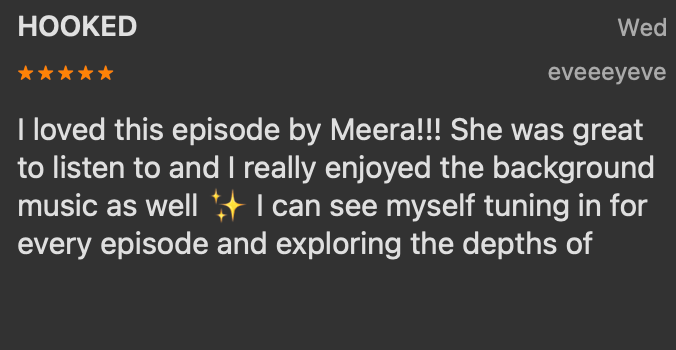
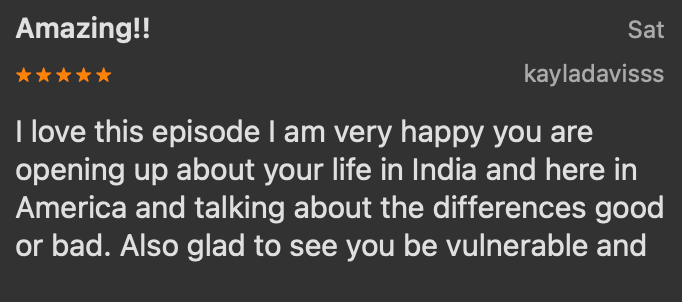
Thank you SO much. I appreciate you SO MUCH.
As for today’s Chai Spiced controversy- Should you separate artist from the art? Would you still listen to, watch, or share art if the artist did something you didn’t agree with?
If you have found value in this podcast please please leave me a review, rating, comment and tell me what’s on your mind. If you have a friend you think might benefit from this podcast please feel free to share!
Thank you and have a wonderful rest of your day.
https://www.britannica.com/topic/social-identity-theory
https://www.apa.org/science/about/psa/2019/07/multiple-identities
https://cdn.vanderbilt.edu/vu-wp0/wp-content/uploads/sites/140/2016/04/27192427/Social-Identity.pdf
https://www.womankind.org.uk/intersectionality-101-what-is-it-and-why-is-it-important/
 HOME
HOME 
Leave a comment